

Teach: what your operator knows
The first three documents, reading the gaps list, and the difference between teaching a pattern and correcting a fact.
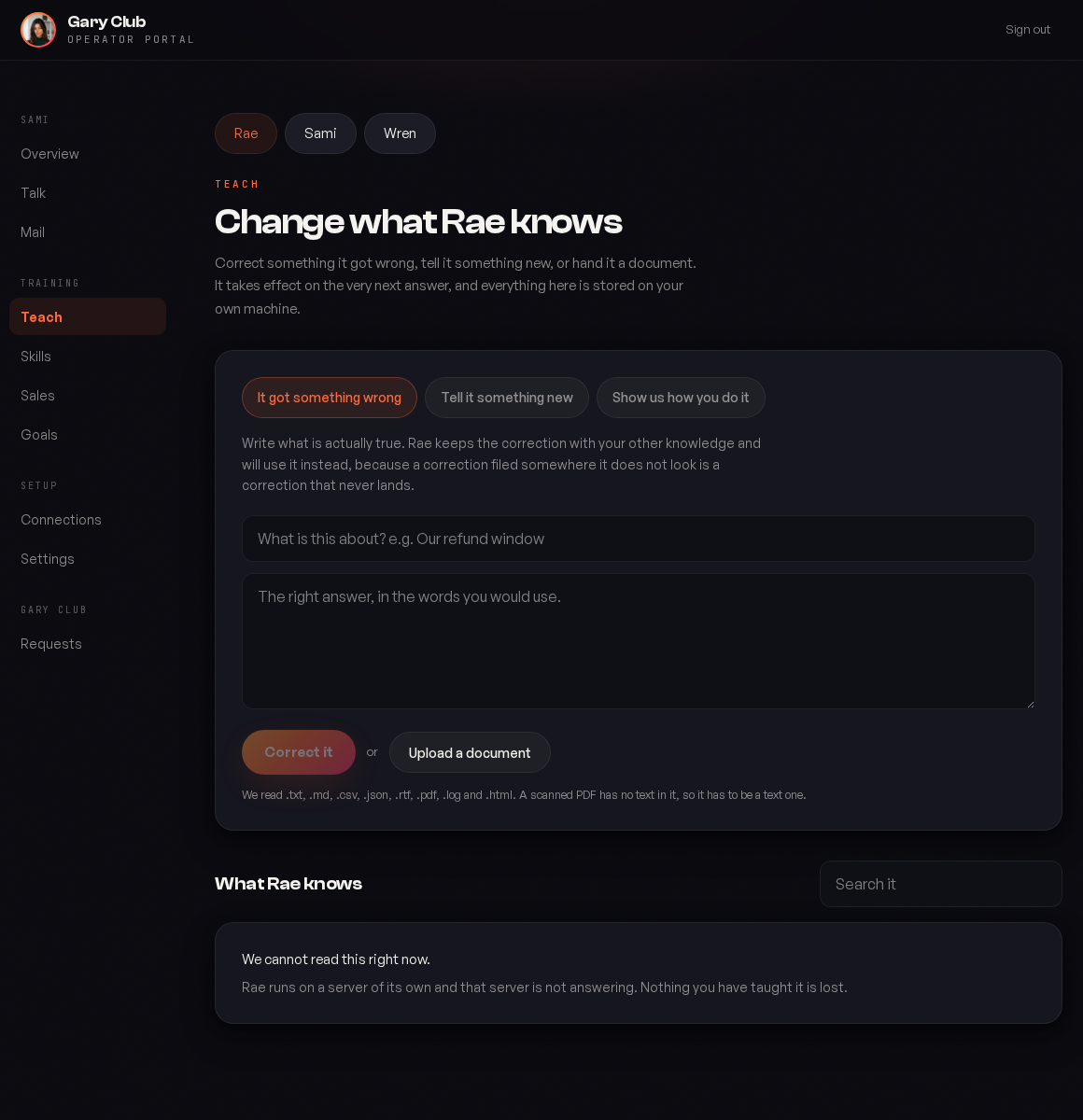
Teach is your operator's knowledge. Everything it knows about your business that is not in its character came from here, and the gap between an operator that sounds generic and one that sounds like a member of your team is almost always this screen.
Knowledge files at zero is the most common problem we see
A brand new operator has a character and no knowledge. It will still answer, warmly and in your voice, and it will be vague, because it has nothing specific to be precise about.
If Knowledge files on your Overview says 0 a week after go live, that is the thing to fix before anything else. It is a bigger lever than any setting on Skills.
The first three documents
Not your whole Google Drive. Three documents get you most of the way, and you can tell which three by asking what a new hire would need on day one.
What you sell, and what it costs
The offer in your own words, with the real numbers and the real tiers. If pricing is a ladder, give it the whole ladder: publishing one number where there are five is how an operator quotes the wrong one.
The objections you hear most
The five things prospects actually say, and how your best closer answers them. This is the document that changes the quality of replies the most.
What happens after someone buys
Onboarding, timelines, what you need from them. Most post sale questions are this document, and without it your operator will hedge.
Give it the document your team already uses rather than writing something new for the operator. A sales script that exists and is slightly messy beats a polished one that never gets written.
Gaps: the questions it could not answer
When your operator is asked something it does not know, it says so rather than inventing an answer, and it records the question. That list is the most valuable thing on this screen, because it is written by your actual customers rather than by you guessing.
| What you see | What it usually means |
|---|---|
| The same question three times | A real gap. Write two paragraphs and it is closed forever. |
| A question you thought was covered | The document exists but does not say it plainly enough to be found. |
| A question you would not answer either | Leave it. A gap is not automatically a failing. |
Teaching a pattern versus correcting a fact
This is the distinction that decides whether a correction sticks.
| You want to... | Do it in | Because |
|---|---|---|
| Fix one customer's record | Talk | It is a fact about a person, not a rule about your business. |
| Stop it offering a discount it should not | Teach | It is a rule, and a rule corrected per conversation comes back the moment nobody is watching. |
| Change how it opens an email | Teach | Same reason. Voice is a pattern. |
| Tell it today's webinar moved | Talk | Temporary fact. It does not belong in permanent knowledge. |
A useful test: would this still be true in six months for a customer you have not met? If yes, it belongs in Teach.
It keeps learning on its own
Your operator adds to its own knowledge from what actually happens: the calls it reads, the threads it is in, the answers you give it. You are not the only author, and the gaps list shrinks on its own as real conversations fill it in.
Ordinary business documents. If your team can read it, it can generally read it. Very long documents are fine; it does not need them trimmed.
It uses documents to understand and then answers in its own voice. It does not paste passages at customers, and it does not send the document itself unless you have told it to.
Yes, and say so plainly in the document. It distinguishes between what it uses to understand and what it may say out loud.
No. Knowledge is what it knows; Skills is what it may do. They are separate on purpose.
What good knowledge looks like
The instinct is to write for a machine. Do not. Write what you would give a capable new hire on their first morning, in the words you would actually use.
| Works well | Works badly |
|---|---|
| Your real sales script, including the awkward parts | A polished summary written specially for the operator |
| The pricing ladder with every tier and what each includes | One headline price |
| Actual objections in the customer's own phrasing | A list of features |
| What you will not do, and why | Only what you will do |
| A case study with the numbers in it | A testimonial |
The thing most worth writing that probably does not exist yet: what you refuse, and why. Who you turn away, what you will not promise, where you tell people you are the wrong fit. Nothing improves an operator's judgement faster, and almost nobody has it written down.
Pricing deserves its own document
It is the single most common cause of a hedged, vague reply. An operator given one number where there are five tiers will avoid the subject rather than risk quoting the wrong one, and avoiding the subject reads as evasiveness to a prospect.
Every tier, with what each includes
Not just the headline.
What moves someone between tiers
So it can tell which one a prospect is actually in.
Any time limited pricing, and exactly how the clock works
If a price expires 24 hours after a call, say that it runs from the end of the call. That precision is what lets it quote a deadline correctly rather than approximately.
What is negotiable and what is not
If nothing is, say so. It will stop implying otherwise.
Working the gaps list
A weekly habit worth ten minutes: open the gaps, and deal with them in three buckets.
| Bucket | Action |
|---|---|
| Asked more than twice | Write two paragraphs. Closed forever. |
| Asked once, and reasonable | Leave it. One person asking is not yet a pattern. |
| Asked once, and revealing | Sometimes the most valuable item on the list. A question you never thought a customer would ask usually means your positioning says something you did not intend. |
The gaps list is written by your customers, not by you. That makes it a better guide to what your material is missing than any audit you could do of your own documents.
Keeping it current
Knowledge goes stale the same way a wiki does. Two habits prevent the usual decay:
When something changes, change it here the same day
Pricing, packaging, a policy. Your operator will keep confidently telling customers the old thing otherwise, and it will sound completely certain.
Re read the objections document once a quarter
Objections move as your market moves. The five you heard last year are rarely the five you hear now.
Was this page helpful?