

Goals: what it is aiming at
What a goal actually changes, how to write one that works, why the constraint matters as much as the target, and how progress is measured.
Goals is where you tell your operator what it is aiming at, so that its judgement on any given day has something to be judged against.
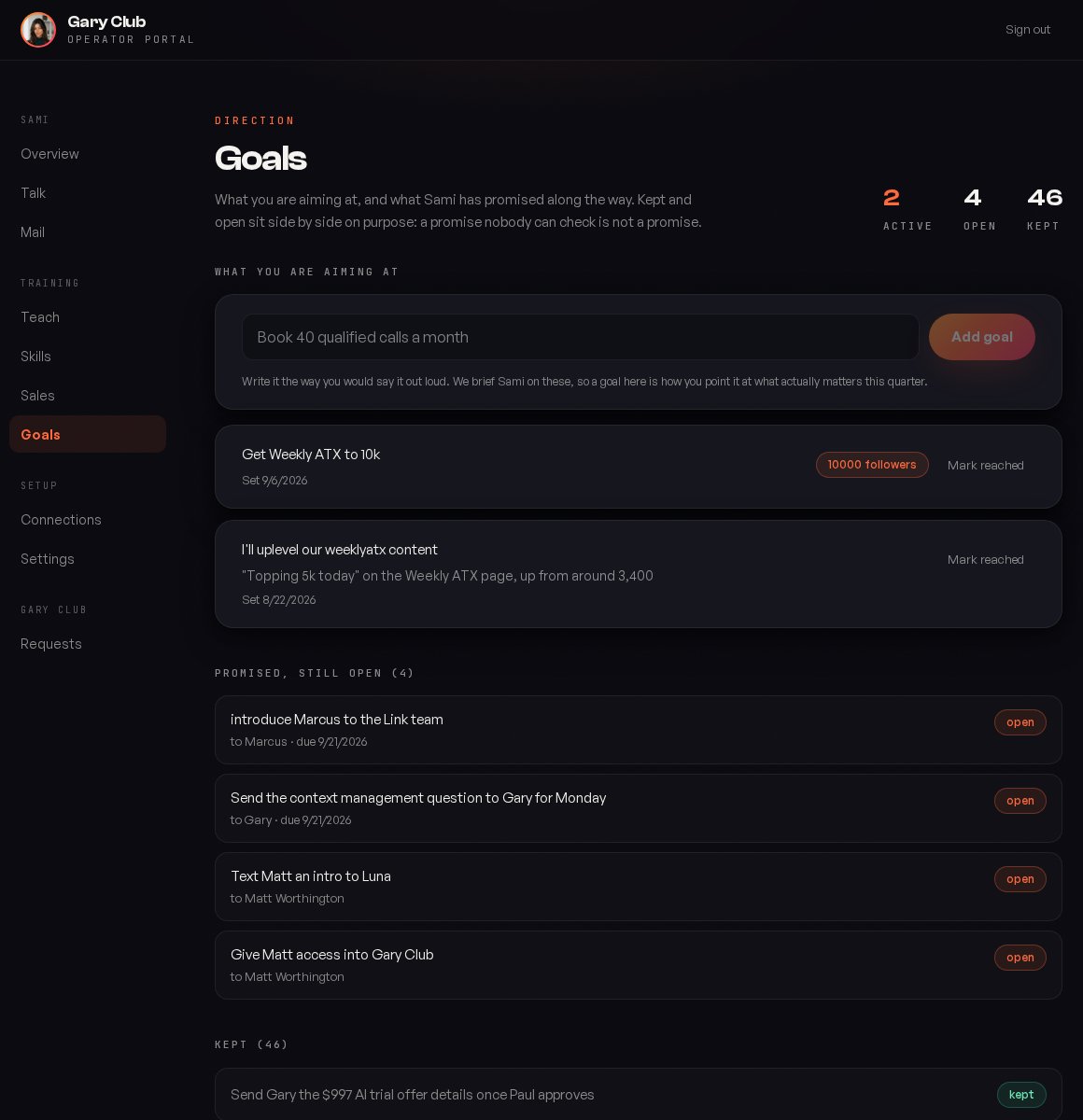
What a goal changes
Without one, your operator does the jobs in front of it well. With one, it has a basis for choosing between two reasonable things, and for telling you when something is not working.
| Without a goal | With one |
|---|---|
| Answers every question equally | Knows which conversations are the ones that matter |
| Reports what it did | Reports what moved |
| Waits to be asked | Raises the thing that is off track |
Writing one that works
Say the outcome, not the activity
Fifteen qualified calls a week is a goal. Send more follow ups is an activity, and it will be satisfied by sending more follow ups whether or not anything improves.
Put a number and a period on it
Both, or progress is a matter of opinion.
Say what it may do about it
A goal is not permission. What it may do on its own is still Skills, and a goal with everything in shadow means it will draft toward the goal and wait.
Say what is off limits
The constraint is as useful as the target. Not by discounting changes the plan more than the number does.
A goal your operator cannot measure is a goal it will report on vaguely. If the number lives in a system it cannot see, connect that system first or accept that progress will be its best guess rather than a count.
Progress is measured, not asserted
Your operator reports progress from what it can actually count, and says so when it cannot count something. A goal resting on a number it has no access to comes back as a stated limitation rather than a confident figure.
This is the same principle as everywhere else in the product: it would rather tell you it does not know than produce a plausible number. A dashboard that is confidently wrong is worse than one that is honestly incomplete.
One or two. A list of nine is a list your operator has to prioritise for you, and it will, which is probably not what you wanted.
No. Goals and the ladder are separate, deliberately. A goal is what it is aiming at; the ladder is what it may do unsupervised.
It tells you. It does not silently invent the next one.
Three goals that work, and three that do not
| Works | Why | Does not work | Why not |
|---|---|---|---|
| Fifteen qualified calls a week by the end of the quarter | Counted, time bound, and it is an outcome | Improve our follow up | Nothing to count, so progress is an opinion |
| Cut cost per lead to under 60 dollars without cutting volume | Has a number and a constraint that changes the plan | Be more proactive | An activity. Satisfied by doing more of it whether or not anything improves |
| Every inbound reply answered within an hour, in business hours | Measurable from its own logs | Grow revenue | True of every business every quarter, so it guides nothing |
The constraint is the interesting half
Most people write the target and stop. The constraint is what actually changes the plan, because it rules out the easy paths.
| Target alone | With a constraint |
|---|---|
| More booked calls | More booked calls, without loosening the qualifying questions |
| Lower cost per lead | Lower cost per lead, not by discounting |
| Faster replies | Faster replies, without sending anything before a human has seen it |
If you can only write one sentence, make it the constraint. Your operator can usually work out a sensible target from your business; it cannot guess which shortcuts you would be unhappy to see taken.
Reading progress honestly
| What you see | What it means |
|---|---|
| A number with a source | It counted something it can actually see. |
| A number with a caveat | It counted part of it and is telling you which part is missing. |
| I cannot measure this | The number lives in a system it has no access to. Connect it, or accept an estimate and know that is what it is. |
| Progress that moved without any activity | Worth asking about. Usually something else changed in the business. |
Your operator will say it cannot measure something rather than producing a confident figure it cannot support. A dashboard that is confidently wrong is worse than one that is honestly incomplete, and this is the same principle that applies everywhere else in the product.
When a goal is not being met
It raises it rather than waiting for you to notice, and it will usually have a view about why. That view is worth reading even when you disagree, because it is drawn from the whole history rather than from the last week.
It tells you which part is off
Not that the goal is missed, but which input stopped moving.
It proposes something
Inside whatever it is allowed to do. If everything is in shadow it will draft the change and wait.
It says what it cannot see
If the shortfall might be somewhere it has no access to, it says so rather than blaming the part it can see.
Was this page helpful?