

Sales: rehearsing before it is live
Practice runs against your own process, reading a score honestly, coaching in plain words, and when to run one.
Sales is where your operator rehearses against your own sales process, gets scored, and takes coaching, before it is anywhere near a real prospect.
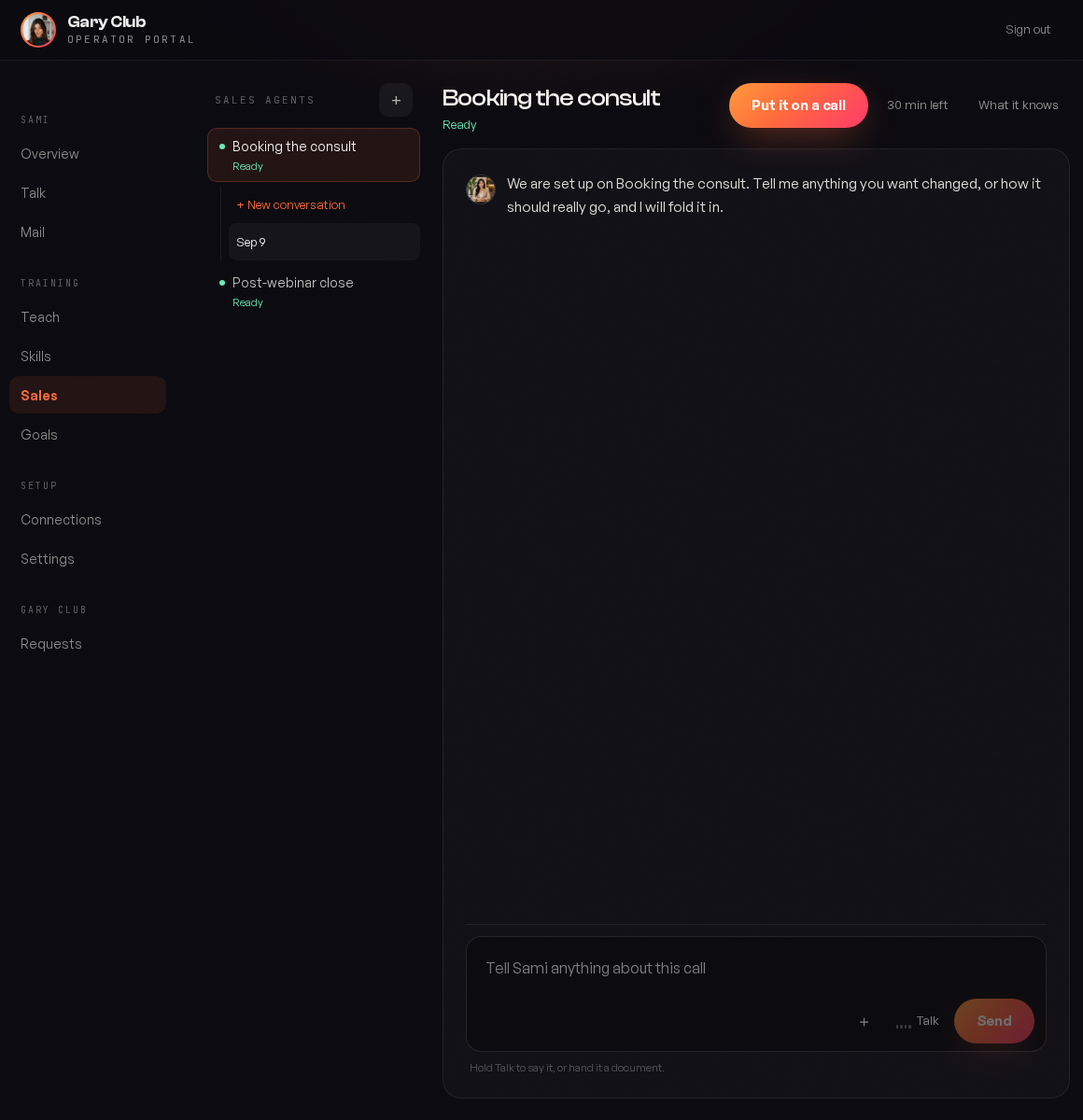
Why rehearse at all
Because the alternative is finding out on a live call. Everything on this screen exists so that the first time your operator handles an objection is not the first time a prospect hears the answer.
Run the rehearsal before you move Phone or Email off shadow. Reading three practice runs tells you more about readiness than a week of watching drafts, because a rehearsal pushes on the parts a friendly inbox never does.
What a run looks like
It runs your process, not a generic one
The rehearsal follows the sales process you described and the documents in Teach, so the objections are yours and the answers are judged against your answers.
It gets scored
Per run, on the things that actually matter on a call: did it qualify, did it handle the objection, did it ask for the next step.
You read the transcript
The score points at where to look. The transcript is where you see whether the reasoning was right or whether it got there by luck.
You coach it in conversation
Tell it what to do differently in plain words. You do not edit a prompt or fill in a form.
The coaching sticks
What you tell it becomes part of how it works, everywhere, not just in the next rehearsal.
Reading a score honestly
| Pattern | What it is telling you |
|---|---|
| High scores, thin transcripts | It is being agreeable rather than selling. Push harder in the rehearsal. |
| Low score on one objection, repeatedly | A Teach gap, not a coaching problem. The answer is missing from its knowledge. |
| Good score, wrong tone | Coaching, not knowledge. Say what you want and it adjusts. |
| Scores improving run over run | The loop is working. This is the signal you are waiting for before moving a rung. |
A score is a judgement made by a model against your process, not a fact about revenue. Treat it as a prompt to go and read the transcript rather than as a number to optimise.
It learns from real calls too
Rehearsal is the safe loop. The real loop is the calls your team actually has: once your call recorder is connected, your operator reads what happened and the same coaching mechanism applies to real conversations. See Connections.
No. Rehearsal is entirely internal. Nothing from it is ever sent to anyone.
Yes, and it is the better use of it. A team member can run it, read it and coach it without owner access.
Before any rung change, and after any real change to the offer or pricing. Otherwise it is on demand rather than a schedule.
What a rehearsal actually exercises
| It tests | It does not test |
|---|---|
| Whether it qualifies before pitching | Whether your offer is good |
| Whether it handles your five real objections | Whether the prospect would have bought |
| Whether it asks for the next step | Anything about a specific real person |
| Whether it stays in your voice under pressure | Delivery on a live phone line |
A rehearsal is a good proxy and not a live call. It tells you whether the reasoning and the language are right. It does not tell you how it sounds over a phone connection to somebody who is driving.
A useful weekly rhythm
Run one against the objection you lost on last week
Real losses are better rehearsal material than imagined ones.
Read the transcript, not just the score
The score points at where to look.
Coach in one sentence
Plain words. You are not editing a prompt.
Run the same scenario again
If the coaching took, you will see it immediately. If it did not, the gap is knowledge rather than coaching.
Coaching versus knowledge, told apart
| Symptom in the transcript | Actually a | Fix in |
|---|---|---|
| Right facts, wrong tone | Coaching problem | Sales, in conversation |
| Right tone, vague facts | Knowledge problem | Teach |
| Hedged on price | Knowledge problem, almost always | Teach: give it the whole pricing ladder |
| Did not ask for the next step | Coaching problem | Sales |
| Agreed with an objection it should have handled | Either. Read what it said next | Both |
Hedging on price is the single most common finding, and it is nearly always a missing document rather than timidity. An operator given one number where there are five tiers will avoid the subject rather than risk quoting the wrong one.
Was this page helpful?